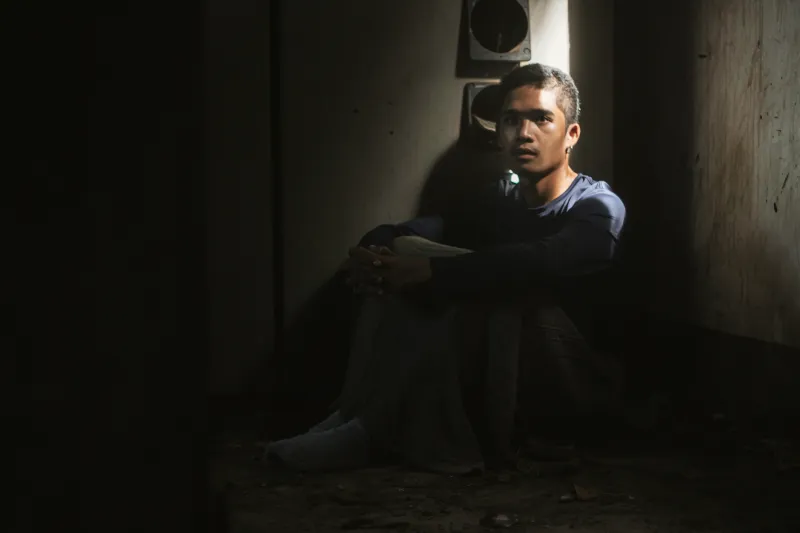
Forgiving the Person in the Save File: Indie Games That Make You Reckon With Yourself

There's a version of self-forgiveness that shows up in a lot of media — the kind where a character has a quiet cry, says something meaningful to their reflection, and comes out the other side basically fine. It's clean. It's satisfying. And it almost never resembles what the real thing actually feels like.
The real thing is messy. It circles back. It requires you to hold two things at once: the fact that you did something you're not proud of, and the fact that you still deserve to keep going. That's not a montage. That's work.
A small but growing number of indie games are taking that work seriously — not by making self-forgiveness easy, and not by making it impossible, but by giving you a space to actually do it. To sit with what you did, understand why, and figure out whether you can let yourself off the hook without pretending it didn't happen.
These are some of those games.
Celeste — The Mountain Isn't the Point
You've probably heard about Celeste in the context of anxiety or mental health. But there's a layer to it that doesn't get talked about as much: the way it handles Madeline's relationship with herself — specifically, with the parts of herself she's been trying to outrun.
The antagonist of Celeste isn't the mountain. It's Madeline's own self-contempt. The game is careful about this. It doesn't frame that contempt as something to be destroyed or overcome through willpower. Instead, it asks Madeline — and by extension, you — to stop treating her darker impulses as a separate, lesser thing. The resolution isn't "beat the bad part of you." It's something closer to: you can't leave her behind, so you might as well figure out how to carry her.
That's a meaningful distinction. Self-forgiveness in Celeste isn't about absolution. It's about integration. About deciding that the parts of you that struggle and fail and spiral are still, actually, you — and that's okay.
Night in the Woods — Mistakes You Can't Unsee
Mae Borowski comes home to Possum Springs having dropped out of college and said some things she can't take back. Night in the Woods doesn't let her off easy. It also doesn't punish her indefinitely. It does something harder: it makes her — and you — sit with the people she hurt and keep showing up anyway.
What the game understands is that self-forgiveness often requires other people. Not to absolve you, but to witness you trying. Mae's friendships are complicated and sometimes painful, and a lot of that pain is her fault. The game doesn't resolve that cleanly. But it does show her choosing, over and over, to stay present — to not disappear into self-loathing when things get hard.
There's something very true about that. The work of forgiving yourself often looks less like a breakthrough moment and more like just... continuing to show up. Doing the next thing. Not because you've fully made peace with what you did, but because the alternative — total withdrawal — helps no one, including you.
Disco Elysium — Accountability Without Annihilation
The protagonist of Disco Elysium has done genuinely terrible things. The game doesn't hide this. It also doesn't ask you to spend the entire runtime flagellating yourself about it.
What Disco Elysium does instead is remarkable: it separates accountability from self-destruction. Harry Du Bois can take responsibility for his failures — professionally, personally, romantically — without the game demanding that he hate himself as payment. The internal voices that make up his psyche argue constantly about what he's done and what he owes, but the game is smart enough to know that endless self-punishment isn't the same as actually reckoning with anything.
There's a version of Harry that uses his guilt as a kind of identity — I am the guy who destroyed everything, therefore I don't have to try. The game pushes back on that. Quietly, but firmly. Self-forgiveness in Disco Elysium looks like deciding to be a detective again. Deciding to care about something again. Not because you've earned it, but because waiting until you've earned it is just another way of never moving.
Spiritfarer — Letting Go of Your Own Expectations
Spiritfarer is mostly understood as a game about grief — specifically, about accompanying others as they die. But there's a thread running through it about the ferryman herself, Stella, and the weight she carries around her own sense of inadequacy.
The game is gentle, but it's not soft. Stella is someone who has spent a long time trying to be enough for everyone — and the work of ferrying souls is, in part, the work of finally understanding that she doesn't have to be. Several of the spirits she guides carry their own unresolved guilt, their own self-recrimination, and watching them find peace becomes a mirror for what Stella might be allowed to find too.
Self-forgiveness in Spiritfarer is quiet. It's not announced. But it's there in the way the game asks you to care for others without losing yourself in the process — and in the way it eventually, tenderly, turns that care back around.
Omori — The Cost of Not Forgiving Yourself
This one is harder to talk about without spoilers, but Omori is fundamentally a game about what happens when you refuse to forgive yourself. When you build an entire interior world designed to keep you from having to look at what you did.
The cost of that refusal is the game's central tragedy. Omori doesn't moralize about it. It just shows you, with precision and patience, what prolonged self-punishment actually does — how it doesn't protect you or make things right, how it just keeps you frozen in the worst moment of your life indefinitely.
The path forward in Omori is brutal and earned. It doesn't promise that forgiving yourself will feel good, or that it will make the thing you did okay. It just suggests, carefully, that you might be allowed to keep living anyway.
Why This Matters
Self-forgiveness is one of those concepts that sounds simple until you actually need it. Then it turns out to be one of the more complex emotional negotiations a person can attempt — because it requires you to be honest about what happened, to feel the weight of it, and to somehow decide that you're still worth extending compassion to. All at once. Without letting any of those steps cancel the others out.
Games are actually well-suited to this. They put you inside a perspective. They make you make choices and live with them. They let you fail repeatedly in a contained space where the stakes are real enough to feel but survivable enough to learn from.
The indie games on this list aren't teaching you to let yourself off the hook. They're teaching you something more complicated: that the hook was never supposed to be permanent. That accountability and self-compassion aren't opposites. That you can know what you did, own it fully, and still decide you deserve to move forward.
That's not a small thing. That's maybe the whole thing.